
Acorn-fed ham: the characteristics that make it unique
The Castanoble team · 6 min read
Published on 18 January 2017 · Updated on 9 July 2026
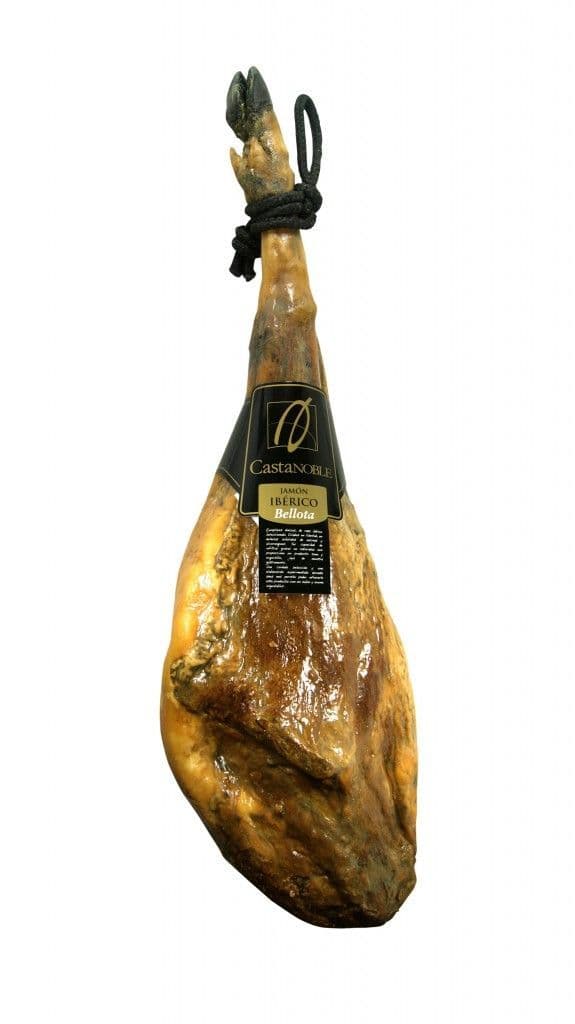
One of the most delicious products of our land is acorn-fed ham: a food of unrivalled flavour, exquisite texture and intoxicating aroma that delights everyone lucky enough to taste it. To recognise a genuine acorn-fed ham, it is essential to look at a series of characteristics that give it its inimitable properties. In this post we go through them one by one.
The origin: Iberico pigs raised roaming freely
Acorn-fed ham comes from Iberico pigs, a breed that is only raised in Spain and that grows up roaming freely in the woodlands, feeding on acorns. Producing a true Iberico ham can take up to three years, and of these only a very small percentage become genuine acorn-fed hams, an exclusive gastronomic product with an exquisite flavour.
Among the characteristics that show a ham to be a true acorn-fed ham, the main one is its provenance: only hams from pigs raised in the dehesas of the Iberian Peninsula can be considered acorn-fed hams. The dehesa is the animal's larder: there it finds the acorns and grass that shape the character of the piece, and there it takes the daily exercise that ends up showing in every slice.
Marbled fat, its hallmark
Iberico ham is characterised by intramuscular, marbled fat. The special genetics of Iberico pigs give them a unique ability to store large deposits of lipids that infiltrate their muscle mass. These deposits are responsible for the marbled veining and for the succulence, aroma and texture characteristic of an Iberico ham. This characteristic is also attributed to the pigs walking through the dehesa, which encourages them to develop less surface fat and more marbled fat.
Requirements to be called acorn-fed ham
- Diet based mainly on acorns and grass during the montanera.
- Minimum weight at slaughter of 140 kilos.
- Minimum age of 14 months.
- Slaughter between late March and mid-April.
When these conditions are met, the Iberico ham is designated “acorn-fed”: a gastronomic pleasure from Iberico pigs reared with care to achieve one of the finest products that nature can offer us.
Why not all Iberico hams are acorn-fed
Raising the pigs that will produce acorn-fed hams requires considerable quantities of this fruit and, consequently, there are not enough dehesas in Spain to feed all Iberico pigs. That is why there is also Iberico free-range grain-fed (de cebo de campo) ham, from pigs that have followed a mixed diet of natural pasture and authorised feed. These are not bad products, but different categories; what matters is knowing what you are buying in each case.
How to recognise it when buying
When buying, the first thing to do is read the label carefully. The name must clearly state that it is an “acorn-fed” ham, together with the animal's percentage of Iberico breed. If the labelling is confusing, mixes terms or avoids mentioning the pig's diet, it is best to be wary: a genuine acorn-fed ham has no need to hide what it is. And a surprisingly low price for what the label promises is usually a bad sign.
It also helps to look at the piece itself. The marbled fat we mentioned can be seen with the naked eye on the cut surface: white veins spread through the lean meat, a sheen on the surface and fat that melts with just the warmth of your fingers. And, as with almost everything we eat, trust in the seller is the best guarantee: at Castanoble we have been in the trade since 1973, and we know that behind every piece there has to be a clear origin and work well done.
Tips for serving it at home
Acorn-fed ham is enjoyed far more when it is served well. Take it out in advance so that the slices reach the table at room temperature, never fridge-cold: it is the marbled fat that carries the aroma, and it needs to warm up to express itself. Cut thin, almost transparent slices, and only as many as are going to be eaten straight away; freshly cut ham always wins. On the plate, spread them out rather than piling them up, so that each one keeps its sheen.
As for accompaniments, less is more: good bread and little fuss around it. Very intense flavours (sauces, strong pickles, powerful dressings) mask precisely the nuances that make this ham unique.
And in the kitchen, always at the end
Acorn-fed ham is at its best raw, just as it comes off the knife. If you still want to add it to a hot dish, add it at the very last moment, off the heat, so that the warmth takes the chill off without cooking it and it does not lose its aroma. The trimmings and cubes left near the bone are excellent for adding depth to stews, creamy soups and stocks: with a piece like this, nothing goes to waste.
Acorn-fed ham is pleasure made food.
In short, acorn-fed ham is one of the greatest delicacies there is: a product that, enjoyed with the moderation befitting any good food, is above all a treat for the palate thanks to its unrivalled flavour.
Frequently asked questions
Are all Iberico hams acorn-fed hams?
No. “Iberico” refers to the breed of the pig, whereas “acorn-fed” refers to its diet during the montanera. A ham can be Iberico without being acorn-fed, as is the case with free-range grain-fed ham. Acorn-fed is the scarcest category, because there is not enough dehesa to feed all Iberico pigs on acorns.
What is the difference between acorn-fed ham and free-range grain-fed ham?
The difference lies in the animal's diet. Acorn-fed ham comes from pigs fed mainly on acorns and grass during the montanera, roaming freely across the dehesa. Free-range grain-fed ham comes from pigs on a mixed diet of natural pasture and approved feed. That difference in lifestyle and diet shows in the aroma, the texture and, naturally, the price.
Why is acorn-fed ham more expensive?
Because it is a scarce product that takes a long time to make. Raising an Iberico pig can take up to three years, and it requires dehesa with enough acorns to feed it in the open. Of all Iberico production, only a very small percentage ends up as acorn-fed ham. Each piece embodies time, space and craftsmanship, and that is reflected in its value.
What gives this ham its marbled fat?
Two factors that go hand in hand. The first is the genetics of the Iberico pig, which can infiltrate fat into the muscle rather than storing it only on the surface. The second is the constant exercise of walking across the dehesa in search of food. The result is the marbled veining that gives acorn-fed ham its characteristic succulence and aroma.
Would you like to try a genuine acorn-fed ham? Patiently cured in our curing house in Castilla y León. We have been in the ham trade since 1973.
See 100% Iberico acorn-fed ham