
Differences between Iberico ham and Serrano ham
The Castanoble team · 4 min read
Published on 4 June 2015 · Updated on 11 October 2026
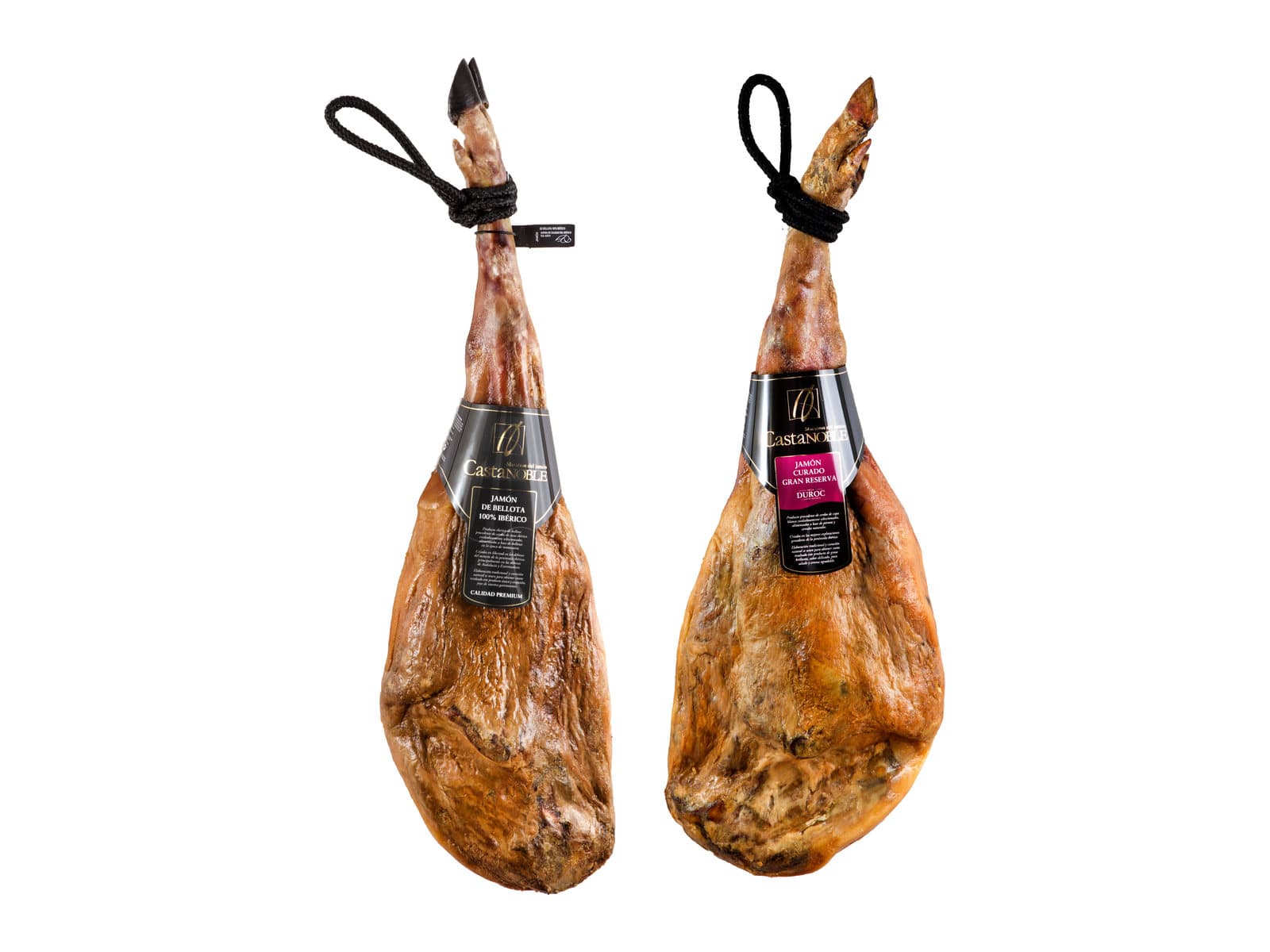
The fundamental difference is the breed of the pig. Iberico ham comes from pigs of the Iberico breed, or from their Duroc cross provided they retain at least half Iberico breed, and it has its own quality standard. The Diccionario de la lengua española defines ‘jamón serrano’ as ‘cured ham’; in practice, the name is given to ham made from all other pigs. Almost all the other differences stem from the breed.
In five lines
- Breed: Iberico (at least 50 %) versus other pig breeds.
- Standard: Iberico has its own (Royal Decree 4/2014); cured ham is governed by the general standard for meat products (Royal Decree 474/2014).
- Minimum curing: 600 or 730 days for Iberico, depending on its weight; cured ham may be called «Gran Reserva» from 15 months.
- On the label: Iberico carries a coloured label; cured ham carries terms such as «bodega», «reserva» or «Gran Reserva».
- Price: Iberico is more expensive, especially de bellota (acorn-fed).
The breed
Iberico is ham from pigs that are at least half Iberico breed. The standard distinguishes «100 % Iberico», from parents that are also 100 % Iberico, and plain «Iberico», which is a Duroc cross and must state its percentage on the label: 75 % or 50 % Iberico breed. Anything else, however good, cannot be called Iberico.
The feed
In Iberico, the feed determines the grade: «de bellota (acorn-fed)» if the pig finishes its fattening in the dehesa eating acorns and pasture, without compound feed; «de cebo de campo (free-range grain-fed)» if it is fed on compound feed and reared outdoors; and «de cebo (grain-fed)» if it is fed on compound feed on a farm. Cured ham has no such grades.
The curing
Iberico is cured for at least 600 days if the piece weighs less than 7 kg and 730 if it weighs 7 kg or more. Cured ham is classified precisely by time: «bodega» or «cava», from 9 months; «reserva» or «añejo», from 12; and «Gran Reserva», from 15. These are minimums: there are Gran Reserva hams of two years and more.
How to tell them apart in the shop
Don't trust the hoof: there are Iberico pigs with light hooves and pigs of other breeds with dark hooves. Look at two things. First, the label: every whole Iberico ham carries a coloured tag on the leg (black, red, green or white); if it doesn't have one, it isn't Iberico. On sliced packs, that same colour appears on the label. Second, the wording: «bodega», «reserva» and «Gran Reserva» are terms for cured ham, and the standard does not allow them to be used for Iberico.
«Bodega», «reserva» and «Gran Reserva» are cured ham terms. An «Iberico Gran Reserva» does not exist.
Flavour and price
Iberico has more fat marbled into the lean meat, and this shows in its juiciness and a longer-lasting flavour, especially in de bellota (acorn-fed). Cured ham has less marbling and a milder flavour. The price follows the breed, the feed and the time: an Iberico de bellota (acorn-fed) ham costs several times as much as a good cured ham.
And ours?
As well as our Iberico hams, we produce a Gran Reserva cured ham from Duroc cross pigs, cured for more than 24 months in our curing house in Castilla y León: well beyond the 15 required by the standard to bear that name. It is the choice for anyone who wants a good everyday ham without reaching the price of Iberico.
Iberico ham de bellota (acorn-fed), de cebo de campo (free-range grain-fed) and de cebo (grain-fed): whole, boneless or sliced.
See the Iberico hamsOur Duroc cross cured ham, cured for more than 24 months.
See Gran Reserva Cured Ham Cross Breed Duroc