
How to sharpen a ham knife step by step
The Castanoble team · 6 min read
Published on 23 January 2018 · Updated on 9 July 2026
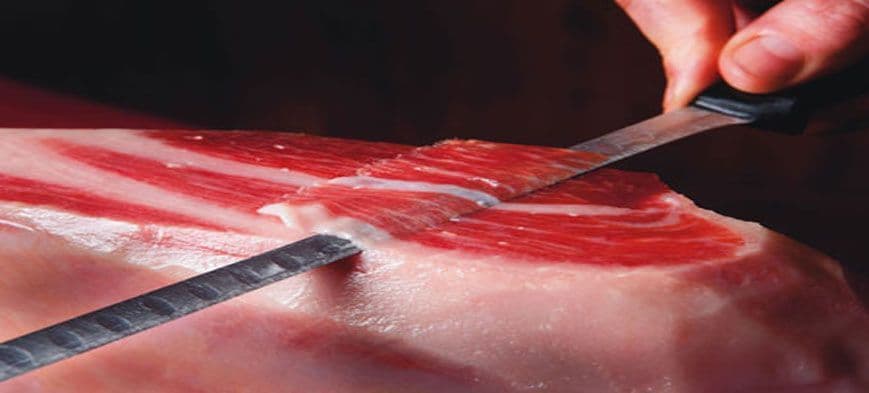
Sharpening a ham knife is an art in itself. In previous posts we have talked about the art of carving a good ham, and today we want to stress the importance of keeping our knives in optimum condition so that slices of Iberico ham come out thin and juicy.
If we want our carving utensils to do their job properly, we must keep them well sharpened. In this way we will also extend their useful life and avoid accidents: when we use a knife with a damaged edge, the hand applies more force and we lose control of the cut. It may seem contradictory, but a sharp knife is always safer than a dull one.
Does your knife need sharpening? Two tricks to check
Before explaining how to sharpen the knife with a honing steel, here are a couple of tricks to check whether it really needs a touch-up:
- Try cutting a sheet of printer paper with the knife. If it cuts the paper without any trouble, the edge is perfect for cutting Iberico ham.
- Very carefully, run the pad of your finger across the blade of the knife, perpendicular to it, as if you were touching the strings of a guitar. If your finger catches slightly, the knife is in optimum condition and does not need sharpening.
An important point: strictly speaking, a honing steel does not sharpen; it realigns and sets the edge. It is the tool for day-to-day maintenance. When the knife has gone a long time without care and no longer responds to the steel, the most sensible thing is to turn to a sharpening stone or a professional knife sharpener.
How to sharpen a ham knife with a honing steel, step by step
If the knife is not properly sharpened, follow these instructions. Hold the honing steel in one hand and the ham knife in the other. The steel should be held with its tip angled slightly upwards.
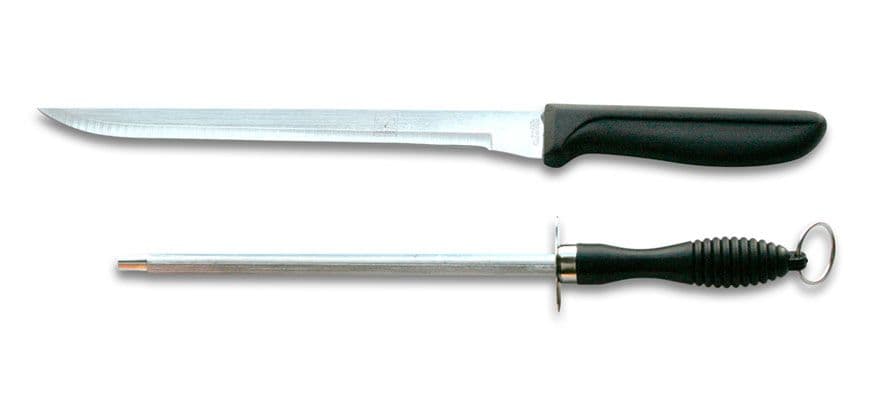
The ham knife, for its part, should be held with the tip of the blade pointing towards the tip of the steel, facing outwards. In addition, the edge should form an angle of about 20º with the steel; otherwise, we will scratch the whole blade.
- Bring the bases of the two tools together and slide the knife along the edge of the steel, keeping the 20º angle, until the two tips meet.
- To work the other side of the blade, repeat the same movement along the underside of the steel.
- Repeat these movements several times until the blade is ready to cut.
- When you have finished, wipe the edge of the knife with a cloth to remove any residue.
The movement should be smooth, with hardly any pressure: it is consistency, not force, that restores the edge. With practice you will find that a few passes on each side are enough to get the blade just right.
Common sharpening mistakes (and how to avoid them)
It is easy to mistreat a knife through haste or habits passed down over the years. These are the most common mistakes when sharpening at home:
- Pressing too hard. Excessive pressure deforms the edge instead of setting it and can scratch the blade.
- Changing the angle with each pass. Keeping a constant angle is more important than speed or the number of repetitions.
- Going too fast. Professionals work quickly because they have been doing it for years; at home, haste only reduces precision and increases the risk of cuts.
- Skipping the final clean. Sharpening can release tiny metal particles that must not end up on the ham: always wipe the blade with a clean cloth before cutting.
- Waiting until the knife no longer cuts at all. It is much easier to keep an edge keen with frequent touch-ups than to restore a completely blunt blade.
How often should you touch up the edge?
There is no fixed rule: it depends on how much you use the knife and how you treat it. Our recommendation is simple: get into the habit of giving it a few light passes on the steel before each carving session, just as professional ham carvers do. And if in doubt, use the paper test and the fingertip test: they will tell you whether it needs a touch-up.
A well-sharpened knife does not just cut better: it is also safer and lasts longer.
Cleaning your ham knife matters too
As well as sharpening, cleaning your knives is important. We recommend washing them by hand in hot water with neutral soap and drying them straight away with a clean cloth, avoiding scourers or other materials that could damage them.
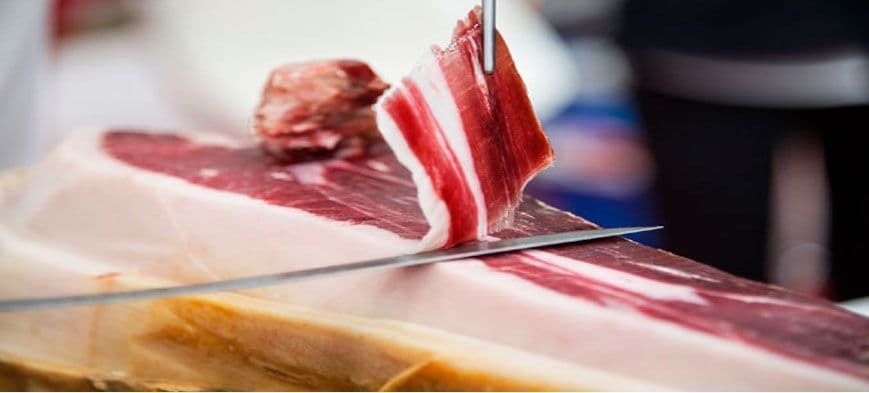
The dishwasher is not the best option, as over time it tends to damage the material. If you still use it, place the knives point down in the basket and apart from the rest of the cutlery, so that they do not knock against each other during the wash.
How to store your knife between uses
There is little point in sharpening a knife properly if we then leave it loose in a drawer, knocking against the rest of the cutlery: every knock nicks the edge and undoes the work of the steel. Ideally, store it with a blade guard or sheath, in a dry place, and always with the blade clean and thoroughly dry: moisture is the main enemy of any steel blade.
A good knife is half the job
However well you sharpen, the result will also depend on the tool. A proper ham knife has a long, narrow, flexible blade, designed to follow the shape of the piece and take off thin slices in a single stroke; an ordinary kitchen knife cannot do that job. Make sure, too, that the handle is comfortable and does not slip, and complete it with a sturdy ham stand that holds the piece securely. A sharp knife, a stable ham stand and a calm approach: that is the whole recipe.
Frequently asked questions about sharpening a ham knife
Honing steel or sharpening stone: which do I need?
For regular maintenance, the honing steel: it realigns the edge and keeps it keen with just a few passes. The sharpening stone comes into play when the blade is genuinely blunt, although it requires more technique. If you do not feel confident with it, a professional knife sharpener will leave the knife as good as new with no risk of damaging it.
Can an ordinary kitchen knife be used to cut ham?
It can get you out of a fix, but it is not what it is meant for. The blade of a ham knife is long, narrow and flexible precisely to produce thin, even slices without tearing the meat. With an ordinary knife the slices will come out thick and uneven, and cutting will be less safe.
Is it safe to test the edge with your finger?
Yes, as long as you do it as we explain: resting your fingertip perpendicular to the blade, gently, and never sliding your finger along the edge. If it makes you nervous, stick to the paper test, which is just as reliable and does not involve touching the blade.
And what if I would rather forget about the knife?
There is a solution for that too. At Castanoble we bone and slice your pieces so that all you have to do is open the pack and serve: the most convenient option if carving is not a habit in your household.
And if you are going to carve at home, do it with the right tool: our ham knife, presented in a deluxe box, is designed to produce fine slices from day one.
See ham knife