
The Iberico pig: origin and characteristics of the breed
The Castanoble team · 6 min read
Published on 17 August 2015 · Updated on 9 July 2026
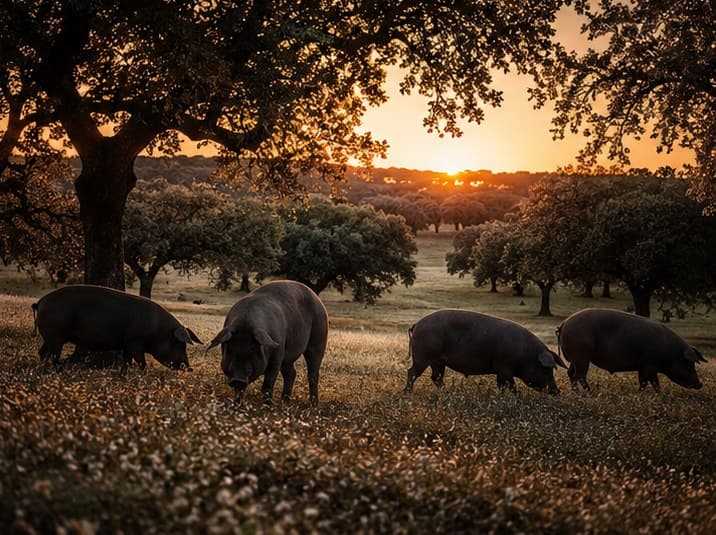
In the making of cured sausages, the choice of raw material is fundamental: depending on the breed of pig, we will obtain one product or another. The clearest example is that of Iberico products, which must come from pigs of the Iberico breed. Bearing this in mind, pig breeds fall into two large groups: Iberico pigs, which we will explore in this article, and white pigs.
Iberico pigs
They are found mainly on the Iberian Peninsula, hence their name. They originate from the Mediterranean, but they are usually reared in the south and south-west, where the dehesas are found: large expanses of land with ideal conditions for rearing Iberico pigs. In our case, the selected Iberico breed comes from the dehesas of Andalusia and Extremadura.
They generally have a black coat and some hair, although there are also redder or hairless Iberico pigs. In terms of physical appearance, they are somewhat finer than other breeds, with a longer, straighter snout. Despite their body mass, they have a very fine, elongated skeleton. Their meat has a texture with little fibre, and their fat is glossy, fluid and soft to the touch.
100% Iberico and Iberico crossed with Duroc
For a pig to be considered of the Iberico breed, the mother must be of the Iberico breed. If the father is too, the ham and the other products will be 100% Iberico, the highest designation recognised by the standard. When the father is not Iberico, the Iberico Quality Standard only permits crossing with the Duroc breed, of American origin: a 100% Iberico mother and a 100% Duroc father produce the 50% Iberico breed pig; and a 100% Iberico mother and a father crossed from Iberico and Duroc produce the 75% one.
The reason the Iberico sow is crossed with this boar is to give the piglets a faster growth rate without noticeably affecting the quality or quantity of the fat. Because of this cross, the pig may have black or reddish hooves, and this trait is not an identifying sign of quality.
A black-coloured hoof is no guarantee of quality: what matters is the breed and how the pig is reared.
What to look for when buying Iberico
As we said, a dark hoof says little on its own: the cross can produce black or reddish hooves, and that detail does not distinguish a good piece from a mediocre one. What really tells you something is the labelling, which shows the animal's percentage of Iberico breed. Our advice is simple: read the label calmly and, if in doubt, ask. In a specialist shop they should be able to explain plainly which animal the piece comes from and how it was reared.
Between a 100% Iberico and one crossed with Duroc there is no right choice and wrong choice: it is a matter of taste. The 100% Iberico offers a more pronounced, slightly rougher flavour, as we mentioned; the cross is milder and gentler on the palate, which is why it is the most widely eaten. If it is your first piece, the cross is usually a safe bet; if you already know the product well, 100% Iberico will give you the truest expression of the breed.
It is also worth thinking about the format. The whole piece is the natural choice if ham is eaten regularly at home and there is someone to carve it; the boneless piece makes carving easier and takes up less room; and sliced ham covers occasional use without wasting anything. No format is better than another: there is a format for every household.
How to serve it so the breed shines
We said that Iberico fat is glossy, fluid and soft to the touch, and this characteristic is most noticeable when it is served: brought properly to room temperature, the slice gains gloss, aroma and richness, whereas straight from the cold it is dull and stiff. With just a few simple steps, any piece looks much better on the table:
- Bring the slices to room temperature before serving: simply leave them out for a while until the fat regains its gloss.
- Cut, or ask for, thin, bite-sized slices: the low-fibre texture of this meat is best enjoyed when the slice almost melts away.
- Serve on a flat plate and spread the slices out without piling them up, so that they come to room temperature evenly.
- Eat it freshly cut whenever you can: that is when the aroma is at its best.
- Serve it with good-quality bread and subtle flavours; very strong dressings mask the nuances of the breed.
Simple ideas for the kitchen
Iberico ham is very versatile beyond the aperitif, as long as it is treated with respect. The general rule is not to cook it: added at the last moment to a warm dish (some sautéed vegetables, freshly cooked eggs, a creamy soup), the heat of the dish itself is enough for the fat to melt and spread its flavour. If it is overcooked, it dries out, becomes salty and loses precisely what makes it special.
The trimmings have their place too: a piece of Iberico fat adds depth to a stock or a pulse dish, and the cubes from the areas near the bone work very well sautéed or in scrambled eggs. With a piece that is well used, almost nothing is thrown away.
Frequently asked questions
Is a black-coloured hoof a guarantee that a ham is Iberico?
No. As we have seen, the Duroc cross can produce black or reddish hooves, and this trait is not an identifying sign of quality. What determines whether a product is Iberico is the breed of the animal, starting with the mother, who must be of the Iberico breed. For any given piece, the label tells you far more than the hoof.
What is the difference between Iberico and 100% Iberico?
For a pig to be considered Iberico, the mother must be of the Iberico breed. If the father is too, the product is 100% Iberico. When the father is of a white breed (usually a Duroc or Duroc Jersey), the result is a crossbred Iberico, milder in flavour and, in fact, the most widely eaten.
Why is the Iberico sow crossed with the Duroc?
Because the offspring grow faster without the quality or quantity of the fat being noticeably affected. It is a well-established cross in the sector, and it explains why much of the Iberico ham consumed does not come from uncrossed Iberico pigs.
Where is the Iberico pig reared?
Mostly on the Iberian Peninsula, especially in the south and south-west, where the dehesas are found: large expanses of land with ideal conditions for rearing them. In our case, we work with Iberico breed from the dehesas of Andalusia and Extremadura.
If you want to taste what this breed reared in the dehesa has to offer, our 100% Iberico acorn-fed (de bellota) ham is its most faithful expression.
See 100% Iberico acorn-fed ham