
Iberico ham: machine-sliced or knife-carved?
The Castanoble team · 6 min read
Published on 17 September 2015 · Updated on 9 July 2026
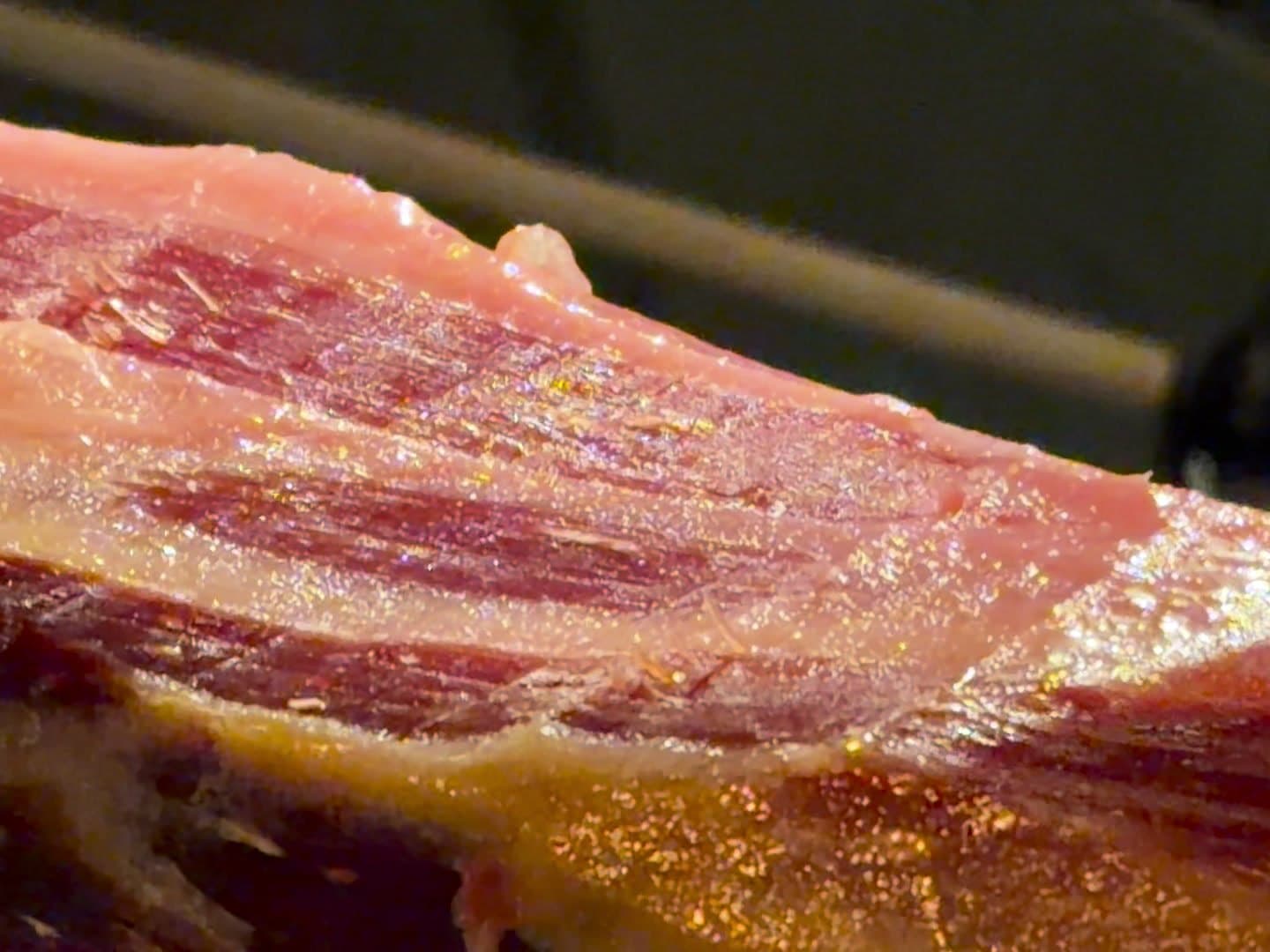
Carving ham with a knife is a famous technique, considered a true art, which was interrupted when technological advances brought the slicing machine: seen by some as a sin and by others as a very convenient and practical invention. The truth is that both methods have their advantages and disadvantages, and today we are going to look at them.
Machine-sliced ham
It is very common for consumers to buy ham already sliced or to slice it at home with a slicing machine, as it is simpler, safer, more convenient and quicker, and does not require much practice. However, this technique has some drawbacks.
Firstly, when we slice ham with a mechanical slicer, we do not make the most of the product's organoleptic qualities. With the machine, the ham heats up from the friction of the blade, which spins at high speed, and the slices lose flavour. Furthermore, this heat causes some of the fat and juice of the ham to disappear, making it harder to distinguish the characteristics and intensity of flavour of each part of the piece.
Secondly, ham is a food whose muscle fibres run in the same direction as its central longitudinal axis, something that is respected when carving with a knife but not when slicing with a machine. That cross cut, rather than a parallel one, makes the slices lose consistency and changes their texture. Carving with a knife and in the direction of the fibres encourages the release of the ham's juice, which gives it that very characteristic sheen.
Knife-carved ham
With knife-carved ham the slices come out smaller, perfect for eating whole in one bite without being awkward or hard to chew: the ham melts in the mouth and we can perceive every nuance of this delicacy.
Furthermore, carving ham with a knife is considered part of ham culture: a true art practised by the master carver who, after much practice, has managed to perfect a far from simple technique and has become an expert who deserves our admiration.
Knife carving is part of ham culture: a true art that deserves our admiration.
It is worth adding that the machine has its advantages: convenience, speed and safety. On top of this, some say that the heat produced by the mechanical slicer intensifies the flavour of the ham. Moreover, nowadays there are machines that allow ham to be sliced parallel to its axis, respecting the fibres.
When each type of cut is best
As with almost everything at the table, the answer depends on the occasion. For everyday use (a sandwich, a quick dinner or some huevos rotos), the machine or ready-prepared slices do the job in minutes. On the other hand, when the ham is the star (a celebration, a meal with guests or a good aperitif), knife carving turns the moment into something special: the piece takes pride of place on the table and every slice comes out just right.
The pace at which it is eaten also matters. If the ham is eaten little by little at home, keeping the piece in the ham stand and carving only what is going to be eaten helps the rest keep better. If you prefer to have it all ready from the start, slicing it all at once is the convenient option: it is divided into portions and taken out as needed.
Tips for carving ham with a knife at home
Carving with a knife is not easy, but you do not need to be a master carver to get by at home either. With some basic notions and the right tools, anyone can produce slices worthy of their piece. These are the tips we give to those starting out:
- Secure the piece firmly in a stable ham stand before making the first cut: safety starts there.
- Use a long, flexible, well-sharpened ham knife, with a paring knife to clean off the rind.
- Remove the rind and outer fat only from the area you are going to eat, not from the whole piece.
- Cut fine, small, even slices, always following the direction of the fibres.
- Always keep your free hand behind the blade and cut moving the knife away from your body.
- When you have finished, cover the cut area with its own fat or with a clean cloth to protect it until the next use.
If you opt for the machine
The slicer also has its technique, and a little basic care makes all the difference:
- Work with a well-sharpened, clean blade: a blade in poor condition tears the slice instead of cutting it.
- Boneless pieces are much easier to handle on a domestic machine than bone-in ham.
- Set the thickness to the minimum: with ham, the finer the slice, the better.
- Always use the pusher or guard and keep your fingers well away from the blade.
- Clean the machine after each use so that fat does not build up.
How to serve the slices so they look their best
No matter how you have cut it, ham is best enjoyed at room temperature. If the slices come from the fridge or from a chilled pack, take them out a while beforehand and wait for the fat to regain its sheen. Spread them out on a large, flat plate, in a single layer and without piling them up. Nothing more is needed: good ham speaks for itself, at most with a little bread.
In the end, the decision is up to each person. How do you prefer it?
Frequently asked questions about carving ham
Is there really a noticeable difference between knife carving and machine slicing?
Yes, above all in the texture. Knife-cutting follows the direction of the fibres and does not warm the ham, so the slice reaches the plate just as it came off the piece. With a machine, the friction of the blade and the cross-cut change the experience. That said, a ham that has been well sliced by machine and properly served is still a pleasure.
Can I slice a whole ham with a machine at home?
With the bone in, it is tricky: home slicers are designed for boneless pieces. If you want your ham sliced, the most practical option is to have the boning and slicing done by professionals; it is a service we offer in our workshop.
How do I store ham once it has been sliced?
Slices lose their qualities sooner than the whole piece, so it is best to eat them as soon as possible. Keep them well covered so they do not dry out and, if they come vacuum-packed, follow the instructions on the packaging and open it a little while before serving.
What do I need to start carving ham with a knife?
Not much: a sturdy ham stand, a long, flexible ham knife, a small paring knife for trimming and a little patience. You pick up the technique by carving; nobody gets perfect slices on day one, and that is fine.
If you fancy trying knife-carving, start with the tool: a good ham knife does half the work.
See ham knife