
Essential ham knives for cutting Iberico ham
The Castanoble team · 5 min read
Published on 17 May 2016 · Updated on 9 July 2026
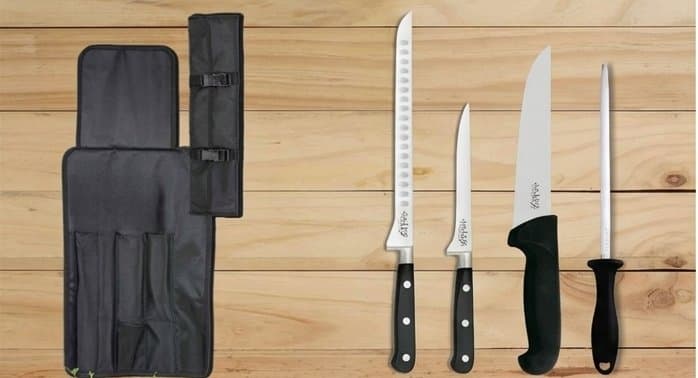
Anyone standing in front of a whole ham for the first time tends to think that a good kitchen knife is enough. The truth is that it is not: each part of the piece calls for a different tool. We see it every day in our workshop, which is why we always recommend starting with the basics: three well-chosen, well-sharpened knives do more for the cut than any trick.
Did you know that to get the best cut of ham you need three types of knife?
- Butcher's knife: with a wide, strong blade, for removing the skin and outer fat from the Iberico ham.
- Ham knife: narrow and flexible, for cutting the slices.
- Boning knife: short and strong, for cutting around the hip.
The butcher's knife is the one that gets the least attention and yet does the hardest work. Its wide, strong blade lets you remove the rind and outer fat without struggling with the piece. It is used to open the ham: the surface is cleaned until you reach the white fat and then the lean meat.
The ham knife is the most recognisable: a long, narrow and flexible blade. That flexibility is not a whim. It is what allows the blade to adapt to the surface of the ham and produce thin, even slices, which is where Iberico ham expresses all its aroma. It is a knife for gliding, not for pressing.
The boning knife, short and sturdy, takes care of the fine work around the bone: it marks, goes round the hip bone and helps you make the most of the areas the ham knife cannot reach. You can tell a ham has been carved thoroughly at the end, when barely any meat is left clinging to the bone.
Sharpening: half the cut
It is essential to sharpen your knives properly before using them. A blunt knife forces you to apply pressure, and pressure is the enemy of a good cut: the slices come out thick and uneven and the risk of an accident increases. Although it may seem the opposite, a well-sharpened knife is safer than a blunt one, because it cuts where you want it to and not where it can.
It is a good idea to run the edge over the honing steel before each carving session and, from time to time, to give it a more thorough sharpening. It also helps to look after your knives as they deserve: wash them by hand, dry them straight away and store them protected, rather than leaving the blades rattling loose in a drawer.
Carving technique
Once we have our knives, let us move on to carving technique. The ham must be held firmly in the ham stand so that it cannot move. We will always hold the ham with one hand while carving with the other, bearing in mind that the holding hand must be above the carving hand. Cuts should always be made in the direction away from the holding hand.
The hand holding the ham must always be above the hand doing the carving: it is the golden rule of knife safety.
A good stand matters as much as a good knife. A stable ham stand, with the piece firmly secured, lets you carve without surprises and work with both hands at ease. If the ham wobbles, no knife can fix it.
Steps for carving
- Remove the rind and the outer fat with the broad knife, starting at the shank.
- Begin carving slices from the maza with the ham knife, always in the direction away from the holding hand and avoiding a crescent-shaped cut.
- With the boning knife, make a precise incision at the hip, located between the maza and the contra; the cut should go round the bone.
- Once the maza is finished, turn the ham over and repeat the same procedure.
Tips for serving freshly carved ham
The ideal slice is thin, almost transparent, and small enough to eat in a single bite. There is no need to cover the plate with mountains of ham: better a few slices spread out well, without piling them up, so that they do not dry out or lose their ideal texture.
Our long-standing advice: carve only what is going to be eaten there and then. Freshly carved ham, served at room temperature, is at its best; the fat glistens and the aroma opens up. Whatever is left over is better kept well covered than left exposed to the air.
How to choose a good ham knife
When buying, look at three things: that the blade is flexible but has backbone, that the handle is comfortable and does not slip, and that the knife is well balanced in the hand. A quality ham knife, well looked after, lasts many years; it is one of those purchases you make once and are always grateful for.
Some models have dimples on the blade, small hollows that help stop the slice sticking to the knife. They are not essential, but they make the job easier, especially for beginners.
Frequently asked questions
Can I carve a ham with an ordinary kitchen knife?
You can, but the result is not the same. An ordinary kitchen knife is too rigid and too short to produce long, thin slices: you will tend to make thick, uneven cuts and waste part of the piece. If you are going to enjoy a whole ham, a ham knife is the most worthwhile investment you can make.
How often should a ham knife be sharpened?
Rather than a fixed rule, what works is habit: a few strokes on the honing steel before each carving session keeps the edge aligned, and a deeper sharpening when you notice the knife starting to need force. If you have to press to make it cut, it is time to sharpen.
In what order are the three knives used?
First the butcher's knife, to clean the rind and outer fat from the area you are going to carve. Then the ham knife, for the slices. The boning knife comes into play around the bones, marking and cutting round them so that the ham knife can work unobstructed. There is no need to trim the whole piece at once: better to uncover only what is going to be eaten.
And what if I don't dare to carve by knife?
That's fine: not everyone has the time or the inclination to learn, and a well-sliced ham is preferable to a badly carved one. In our workshop we bone and slice your pieces, ready for you to open the pack and serve.
And if you want to start carving properly, in our shop we have our ham knife in a black De Luxe box: to give as a gift or to keep for yourself.
See the De Luxe ham knife