
Tools for carving Iberico ham: ham knives, ham stands and boards
The Castanoble team · 6 min read
Published on 21 December 2017 · Updated on 9 July 2026
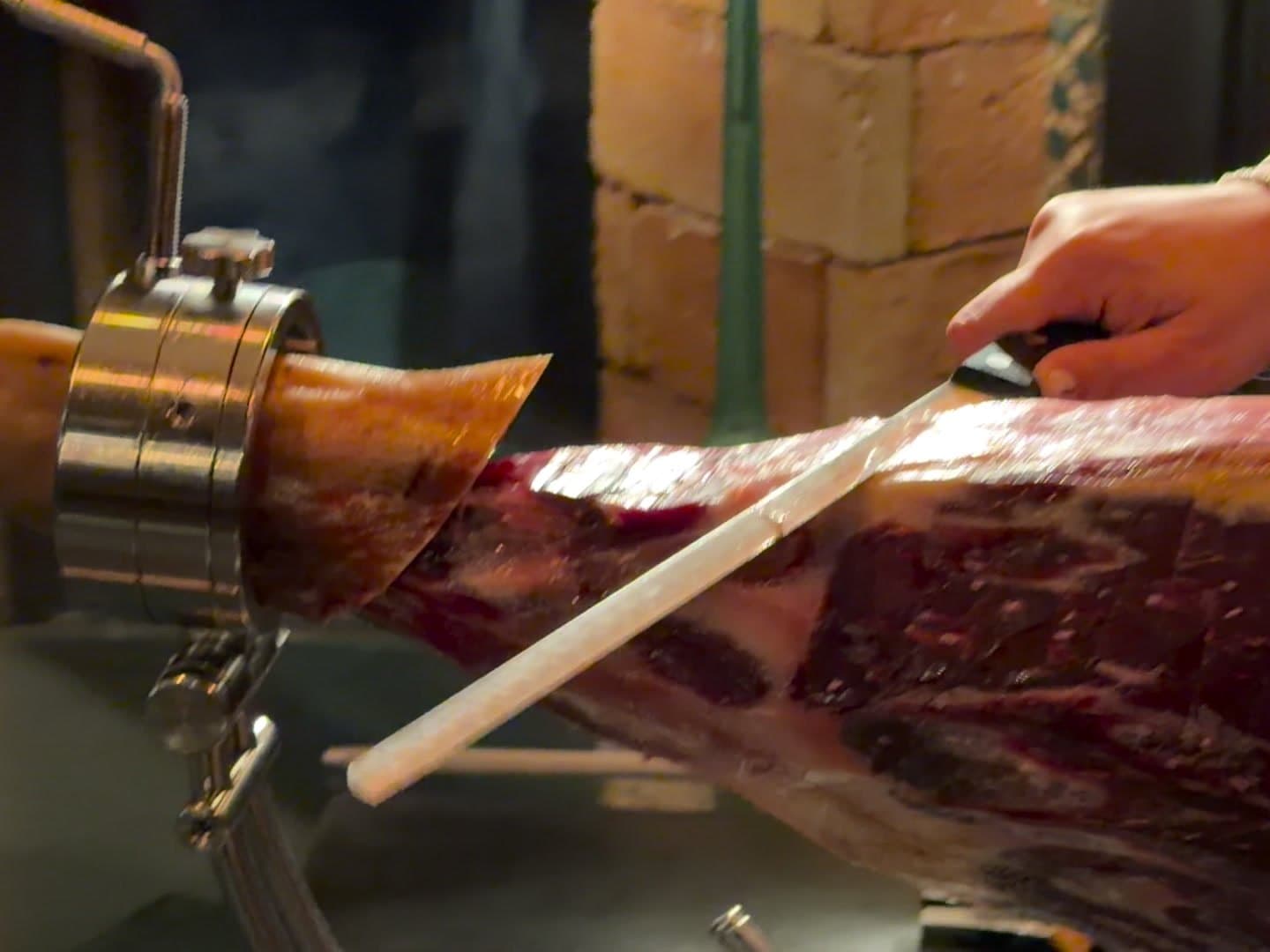
A few posts ago we explained how to carve an Iberico ham properly. Today we want to focus on the tools for carving Iberico ham: ham knives, ham stands and boards. These are the tools you need to achieve the best possible cut.
Tools for carving Iberico ham
A good cut depends on the hand, of course, but also on the tools. With the right equipment, the job is more comfortable and safer, and the result shows on the plate: thin, even, well-presented slices. We go through the items that make up the carver's basic kit.
Ham stand or ham board
First of all, this tool is where we place the ham so that we can carve it comfortably. There are many types: some designed for more professional use and others for home use. There are also completely horizontal ones, which are the most comfortable, and ones with a steeper incline.
It is particularly important to look at the stand's clamp, which is the part that holds the hoof. They can be fixed or rotating. Rotating ones make it much easier to handle the ham when it has to be turned over to continue carving, although these are semi-professional stands.
When choosing a stand, also pay attention to the base: the more stable and solid it is, the better it will perform during carving. Place it on a sturdy table, at a height that lets you work with your arms relaxed and without hunching your back. After each use, a damp cloth and thorough drying are all it needs.
Thanks to the ham stand, the ham will not move while we carve it and we will avoid accidents: make sure it is held securely.
Honing steel
We use it to hone the edge of the knives and keep them in perfect condition. Their size and shape vary considerably: there are both flat and rounded honing steels, with lengths ranging from 20 to 35 cm. The choice depends on which one you find most comfortable when sharpening the knife.
Using a honing steel does not require strength: a few gentle, regular strokes of the edge, always keeping the same angle, before each carving session are enough. Bear in mind, though, that the honing steel hones and aligns the edge but does not restore it. When the knife has truly lost its edge, it is time to turn to a whetstone or a trusted knife sharpener.
Ham knife
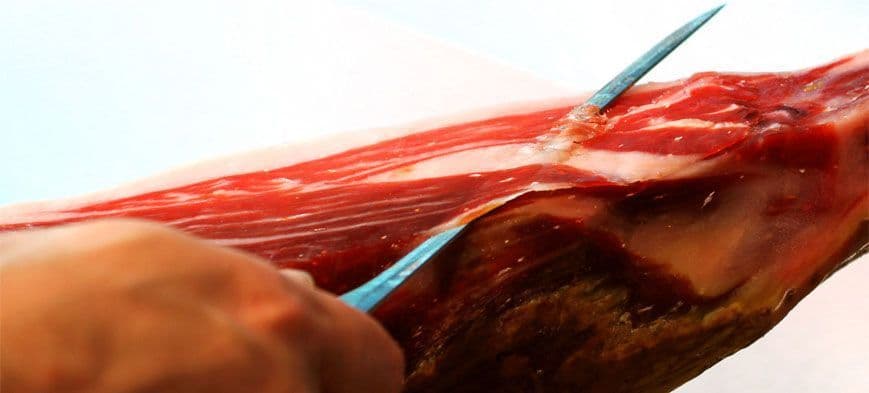
It is a long, very flexible knife with a narrow blade. We will use it exclusively to cut the ham into small, thin slices. Its length ranges from 26 to 40 cm, depending on personal preference and the size of the ham.
We recommend that this knife has dimples on both sides of the blade, which help to release the slice being cut from the ham.
The flexibility of the blade is what allows it to follow the shape of the piece and produce long, very thin slices without forcing the movement. A good, well-cared-for ham knife lasts many years, so it is worth investing in a quality one and reserving it exclusively for ham: using it for other kitchen tasks only damages the edge.
Boning knife
This is the knife used to bone the ham, whether Iberico or Serrano. It has a narrow, hard, pointed steel blade. Its length can range from 6-7 cm to 12-13 cm, and its tip can be rounded or straight. It is important to keep the tip sharp and well maintained so that the meat can be properly separated from the bone.
Skinning knife
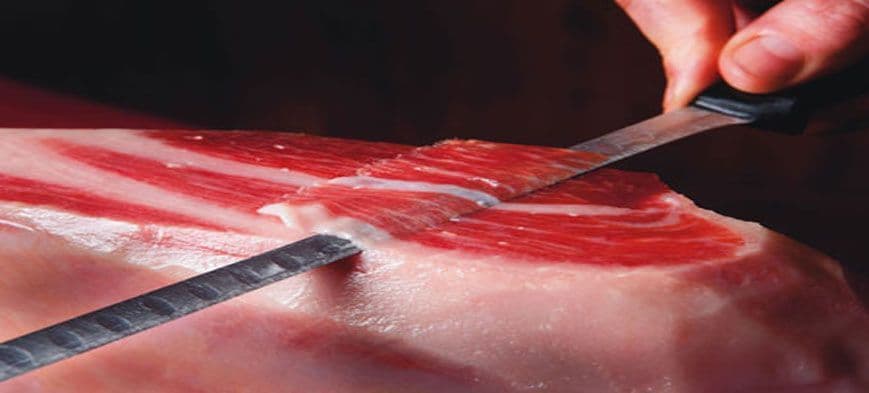
This is the knife we will use to remove the rind from the ham before starting to slice with the ham knife. It has a wide, hard and sturdy steel blade, around 20-22 cm long.
As well as removing the rind at the start, this knife will be useful for trimming the surface during the days the ham is being eaten: before each cut, it is a good idea to remove any outer fat that has been left exposed, so that you always reach clean meat with all its aroma.
Tongs
We will use them to handle freshly cut slices of ham hygienically: with the tongs we pick up the slices and arrange them on the plate following our presentation tips.
Care and maintenance of the utensils
Ham knives are best washed by hand with warm water and soap, and dried immediately with a cloth. The dishwasher is their worst enemy: it damages both the edge and the handle. Nor is it a good idea to leave them loose in a drawer: it is better to keep them in their sheath, their box or a knife block.
With the ham stand the routine is just as simple: clean it after each use, check from time to time that the screws and the clamp are still firm, and store it in a dry place. Well-cared-for equipment is always ready for the next piece.
Safety first
Before you start, check that the ham is held firmly in the stand and that the stand does not wobble on the table. When cutting, your free hand must always stay behind the cutting area, never in front of the blade, and the stroke should move away from your body. And remember: a sharp knife is safer than a blunt one, because it does not force you to strain the movement.
Frequently asked questions about ham-cutting utensils
Can you cut ham with an ordinary kitchen knife?
You can, but the result will not be the same. A kitchen knife, with its wide, rigid blade, produces thick, uneven slices and forces you to strain the movement. The ham knife, long, narrow and flexible, is designed precisely to produce thin, even slices. If you are going to cut a whole piece, the investment is worth it.
What utensils do I need, at a minimum, to get started?
With three items you can do a decent job: a stable ham stand, a ham knife and a short, rigid knife for skinning the piece and trimming the fat. The sharpening steel and the tongs complete the kit and, once you get hooked, you will stop considering them optional.
How do I keep the edge of my ham knife?
With two habits: run it along the sharpening steel before each cutting session to hone the edge, and wash and dry it by hand straight after use. If, even so, the knife stops cutting as it should, take it to be sharpened.
What is the difference between the boning knife and the skinning knife?
The blade and the task. The skinning knife has a wide, sturdy blade, designed to remove the rind and outer fat from the piece. The boning knife, on the other hand, is narrow and pointed, and is used for boning and for precise work close to the bone.
We hope you have found this little «lesson» on ham-cutting tools interesting. If you have any questions, you can drop by our shop in Barcelona, at Passeig Torras i Bages, 117, or call us on (+34) 933 457 245. And if you would rather forget about knives, remember that in our workshop we bone and slice your piece so you can enjoy it ready to serve.
And if you are putting together your cutting kit, start with the key piece: our ham knife with black De Luxe box.
View De Luxe ham knife