
Difference between Iberico shoulder and Iberico ham
The Castanoble team · 3 min read
Published on 18 January 2017 · Updated on 9 July 2026
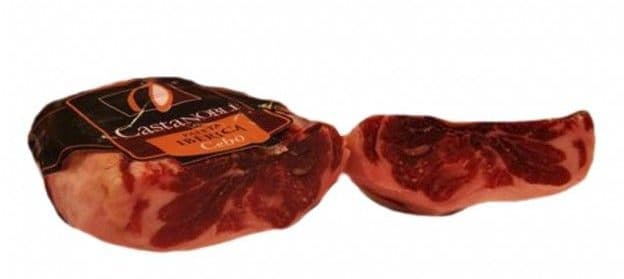
Many consumers still don't know the difference between Iberico shoulder and Iberico ham, and this often leads to confusion. Both pieces come from the Iberico pig, but their characteristics and morphological differences give each product a different flavour, texture and price.
Origin and size of each piece
Iberico shoulder comes from the front leg of the Iberico pig. As a general rule, it weighs more than 4 kg and does not usually exceed 6 kg. Its main characteristic is its smaller size: it is a slimmer piece than Iberico ham and its length does not usually exceed 75 cm. When carved, the slices obtained from the shoulder are thinner and narrower. The ratio of fat to bone is an essential measurement in these products: in a shoulder, fat and bone can account for as much as 60 % of the weight, leaving around 40 % of the bone-in weight usable.
Iberico ham, on the other hand, comes from the hind legs of the Iberico pig. It weighs between 7 and 8.5 kg, although you can even find them at 10 kg. When carved, the slices are larger than those from an Iberico shoulder, and its length is also greater: an Iberico ham typically reaches 85 or 90 cm. The usable percentage, once the bone and fat of the whole piece have been discounted, is around 50 %.
Curing times
The second difference lies in the curing periods. The usual process consists of three stages: salting, drying and maturing. The curing of an Iberico shoulder ranges from 12 to 24 months; an Iberico ham, by contrast, needs more time, with a minimum curing of 24 months, although in our pieces it is usually around 36 months.
Flavour: intensity versus nuance
The third distinguishing aspect is flavour. The morphology and the curing time determine the depth of flavour, the presence of fat and the nuances of the slices. The shoulder is characterised by a more intense and deeper flavour, while the virtue of Iberico ham is its greater richness of nuance. The key lies in its longer curing time.
The shoulder offers a more intense flavour; the ham, a greater richness of nuance.
The difference in price
The fourth difference lies in the price per kilo, which will always be lower for the shoulder and higher for the ham. Furthermore, when it comes to the whole, bone-in piece, the shoulder weighs less by definition, which adds to that lower price per kilo. The curing time also plays a part: Iberico ham can take twice as long to complete the entire production process, so it is only logical that its market value is considerably higher, sometimes reaching almost double that of a shoulder.
Frequently asked questions
Is Iberico shoulder of lower quality than Iberico ham? No. Both pieces come from the same pig and are produced with the same care; they are simply different pieces, with a different size, curing and flavour.
Which piece suits me if there are only a few of us at home? The shoulder is usually a good choice when consumption is more leisurely: being a smaller piece, it is easier to finish it while it is at its best.
Why is Iberico ham more expensive than shoulder? Mainly because of its larger size, its higher yield and a longer curing time, which makes the production process more costly.
Now that you know the differences, a good way to check them for yourself is to start with a manageable piece: our boneless Iberico grain-fed shoulder.
See Iberico grain-fed shoulder