
The Iberico ham label: what the black, red, green and white tags mean
The Castanoble team · 6 min read
Published on 12 September 2026
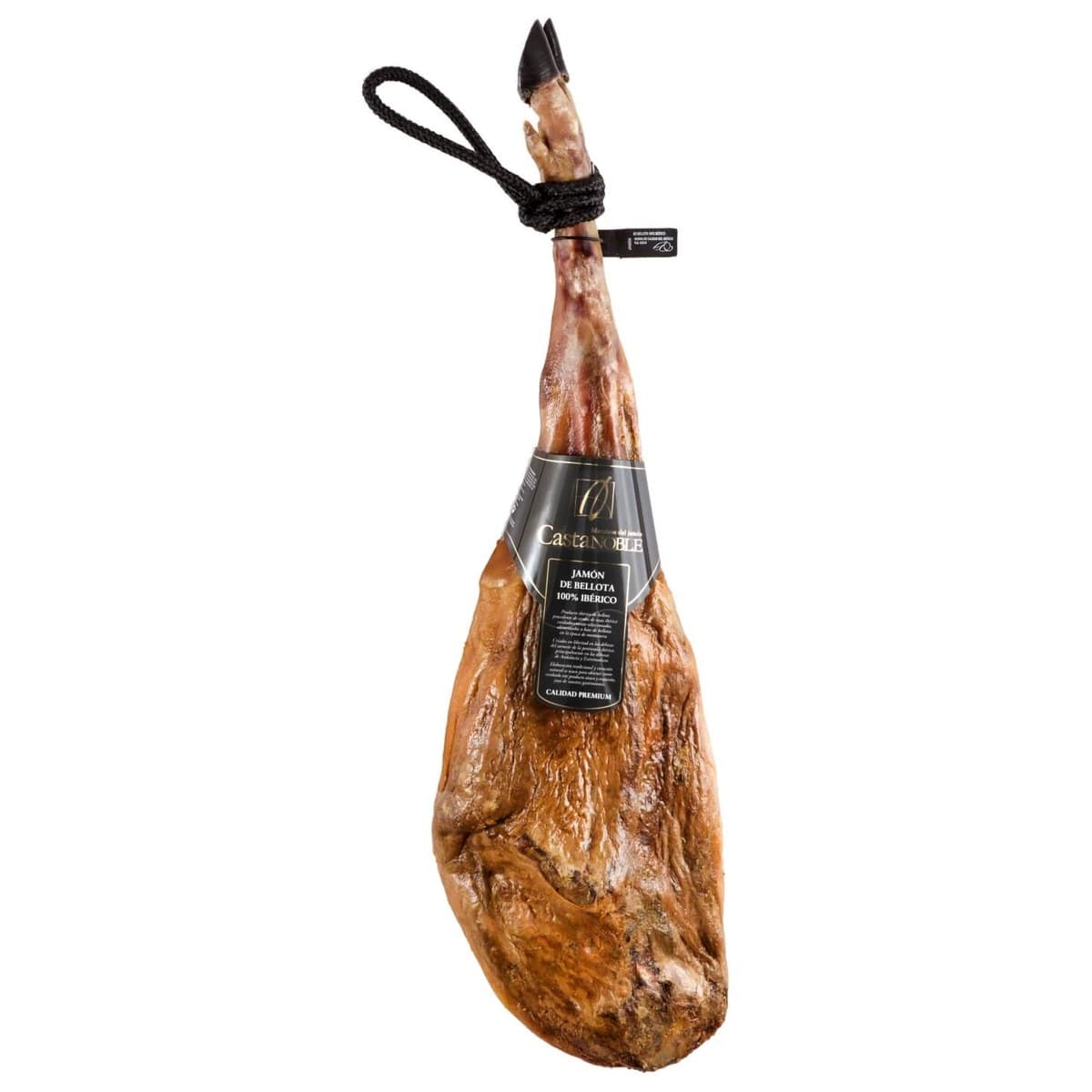
There is one thing on an Iberico ham that does not depend on who is selling it or on how attractive the label is: the coloured label fastened around the shank. It is attached by the slaughterhouse, assigned by the Iberico interprofessional organisation with a unique number for each piece, and the law requires it to remain there right up to the point of sale. There are four colours, and each one says exactly what pig it was and how it was fed. Once you learn to read them, nobody can sell you a grain-fed ham as an acorn-fed one.
Two questions, one colour
The Iberico Quality Standard (Norma de Calidad del Ibérico), in force since 2014, classifies each ham by two things. The first is the pig's diet and husbandry: de bellota (acorn-fed), fattened during the montanera in the dehesa on acorns and pasture; de cebo de campo (free-range grain-fed), raised outdoors on pasture and feed; or de cebo (grain-fed), raised on a farm on feed made from cereals and legumes. The second is the breed: 100% ibérico (100% Iberico), when the pig descends solely from Iberico pigs registered in the herd book, or simply ibérico (Iberico), which allows crosses with at least 50% Iberico breed. The colour of the tag sums up both answers.
Black: de bellota 100% ibérico (100% Iberico acorn-fed)
The very top. A 100% Iberico pig, fattened roaming free in the dehesa during the montanera, eating holm oak and cork oak acorns and the wild grasses. It is the only one that may be called «pata negra»: the Iberico Standard (Royal Decree 4/2014, art. 4.5) reserves that term for the de bellota 100% ibérico (100% Iberico acorn-fed) designation, the one with the black tag. Our 100% Iberico Acorn-Fed Ham is cured for more than four years; the shoulder, for more than two.
Red: de bellota ibérico (Iberico acorn-fed)
The same montanera diet (acorns and pasture in the dehesa, roaming free) with a cross-bred pig, 75% or 50% Iberico breed. The acorn flavour is all there; what changes is the genetics, which in 100% Iberico gives slightly finer fat marbling. For many people it offers the best balance between what you pay and what you enjoy. Our Iberico Acorn-Fed Ham 50% Iberico Breed is cured for more than three years.
Green: de cebo de campo ibérico (Iberico free-range grain-fed)
An Iberico pig raised outdoors: it eats natural cereal feed and, in addition, the grasses and plants it finds. No acorns, but with the exercise and fresh air that show in the meat. Our Iberico Free-Range Grain-Fed Ham 50% Iberico Breed is cured for more than thirty months.
White: de cebo ibérico (Iberico grain-fed)
An Iberico pig raised on a farm on natural cereal feed. It is the gateway to Iberico: the breed brings the fat marbling and the characteristic flavour, and the long curing does the rest. Our Iberico Grain-Fed Ham 50% Iberico Breed is also cured for more than thirty months. It is by far the one most often given as a gift, because it is genuine Iberico at a reasonable price.
And the one without a tag: Gran Reserva cured ham
A ham from a white pig, such as our Gran Reserva Duroc cross, falls outside the Iberico Quality Standard and carries none of the four tags. This is not a flaw: it is a different product, with its own regulations and its own virtues (a long cure, a clean flavour, a modest price). What would be a deception is selling it with a coloured tag, and that does not happen: only the slaughterhouse can fit the tag, and only on an Iberico ham.
Three things the tag does NOT tell you
- How long it has been cured. The standard sets minimums, but a twenty-four-month de bellota (acorn-fed) ham and a forty-eight-month one carry the same black tag. The curing time is shown on the producer's label, and on our product pages it is stated ham by ham.
- Whether the ham is well cured. The tag certifies the origin of the pig, not the craft of the curing house. Two hams with a red tag can be very different.
- Not on sliced products or loins. The packs carry a label in the same colour as the label on the piece they come from, and the cured loin (lomo) has its own marking; none carries a physical label. If someone shows you «the black label» of a pack, be wary.
The tag tells you what pig it was. The time and the craft come from the curing house, and you have to read those on the producer's label, not in the colour.
Each product page shows its label and its months of curing
View hams and shoulders