
White spots in ham: what tyrosine crystals are
The Castanoble team · 5 min read
Published on 10 June 2015 · Updated on 14 October 2026
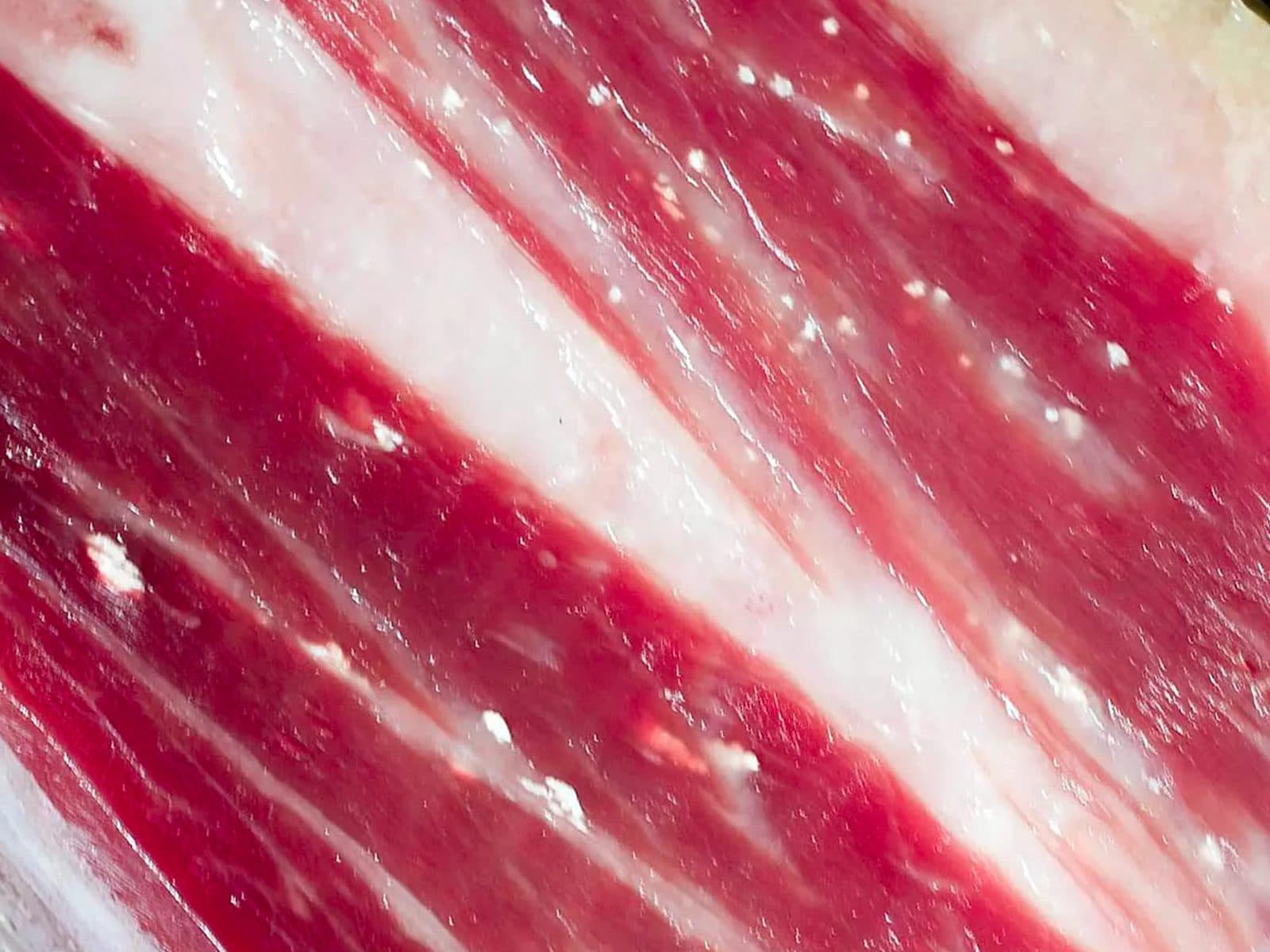
When you cut a cured ham, small, hard, chalky-looking white specks sometimes appear within the meat, scattered here and there. They are not salt, mould or any foreign body: they are tyrosine crystals, an amino acid from the meat itself. They are perfectly safe to eat and, depending on what they look like, they say quite a lot about how the piece was cured.
What tyrosine is and why it crystallises
Meat is mainly protein, and proteins are long chains made up of smaller links: amino acids. During curing, the meat's own enzymes gradually break down these chains. This produces shorter fragments, which make the meat more tender, and free amino acids, which provide much of the aroma and flavour of a cured ham.
Tyrosine is one of these amino acids, with one peculiarity: it dissolves very poorly in water. As the ham dries, it can no longer stay dissolved and precipitates in the form of small crystals. Laboratory analyses confirmed this decades ago: in a study by the CSIC's Institute of Agrochemistry and Food Technology, the white specks in the hams analysed turned out to be tyrosine crystals.
What their size tells you
The same study (Silla, Innerarity and Flores, 1985) compared hams with and without white specks and found two types of crystals. The large ones, 3 to 5 millimetres, few in number and irregularly distributed, appeared in hams with less salt and slow curing, in which the enzymes work for longer. The small ones, from half a millimetre to 2, numerous and spread throughout the meat, appeared in hams with a lot of salt and, judging by their appearance, fast drying. In the tasting, the tasters could tell them apart and preferred the hams with large crystals.
The researchers' conclusion is the one worth remembering: the mere presence of crystals is not enough to indicate quality. What matters is what they are like.
Few and large: the mark of slow curing. Many and tiny: lots of salt and haste.
What the regulations for professional carvers say
The official specialisation course in carving and tasting cured ham and shoulder (Royal Decree 84/2026) says the same. When assessing the appearance of a slice, it counts uniform marbling and ‘some white specks’ as characteristic of good lean meat, and among the defects the professional must be able to detect it lists ‘excessive white specks’. The same regulation treats salt crystallisation and white film as separate defects: they are not the same as tyrosine crystals.
How to tell them apart from other white things
- Tyrosine crystals: inside the meat, on the cut surface. White, hard, stationary specks that crunch slightly when chewed.
- Mould: on the outside, on the rind. It is natural during curing and is removed when the piece is trimmed before starting it.
- Salt crystals: on the surface of the piece or inside the packaging, with a distinctly salty taste. The carvers' regulations count them as a defect.
- If you see a fine powder moving on the surface, it is not tyrosine: check with your shop before continuing.
Should they be removed before eating?
No. They are eaten with the slice, without any problem: at most you will notice a slight crunch. Removing them one by one would be not only unnecessary but also a thankless task, because they are inside the meat. If one slice has a lot of them, mix it with others on the plate.
Frequently asked questions about white spots in ham
Can they be eaten?
Yes. They are an amino acid from the meat itself, not an additive or a foreign body.
Are they salt?
No. Laboratory analysis showed that they are tyrosine. When salt crystallises, it does so mainly on the surface and tastes distinctly salty.
Is a ham without white spots worse?
Not necessarily. Not all hams develop them visibly, and their mere presence proves nothing. What matters is the whole: the aroma, the texture, the flavour and your trust in whoever cured it.
Do they also appear in shoulder?
Yes, in any piece cured for long enough, because the underlying process is the same: proteins that gradually break down during curing.
Sources: M. H. Silla, A. Innerarity and J. Flores, ‘Características de jamones con cristales de tirosina’ (Characteristics of hams with tyrosine crystals), Revista de Agroquímica y Tecnología de Alimentos, Instituto de Agroquímica y Tecnología de Alimentos (CSIC), 1985. Royal Decree 84/2026 of 11 February, specialisation course in Mastery of Carving and Tasting of Cured Ham and Shoulder (BOE of 12 February 2026), tasting module.
If you are looking for a long-cured ham, take a look at our 100% Iberico acorn-fed ham.
See 100% Iberico acorn-fed ham