
How to choose a good ham: what to decide first and what to look for in the ham itself
The Castanoble team · 5 min read
Published on 11 October 2026
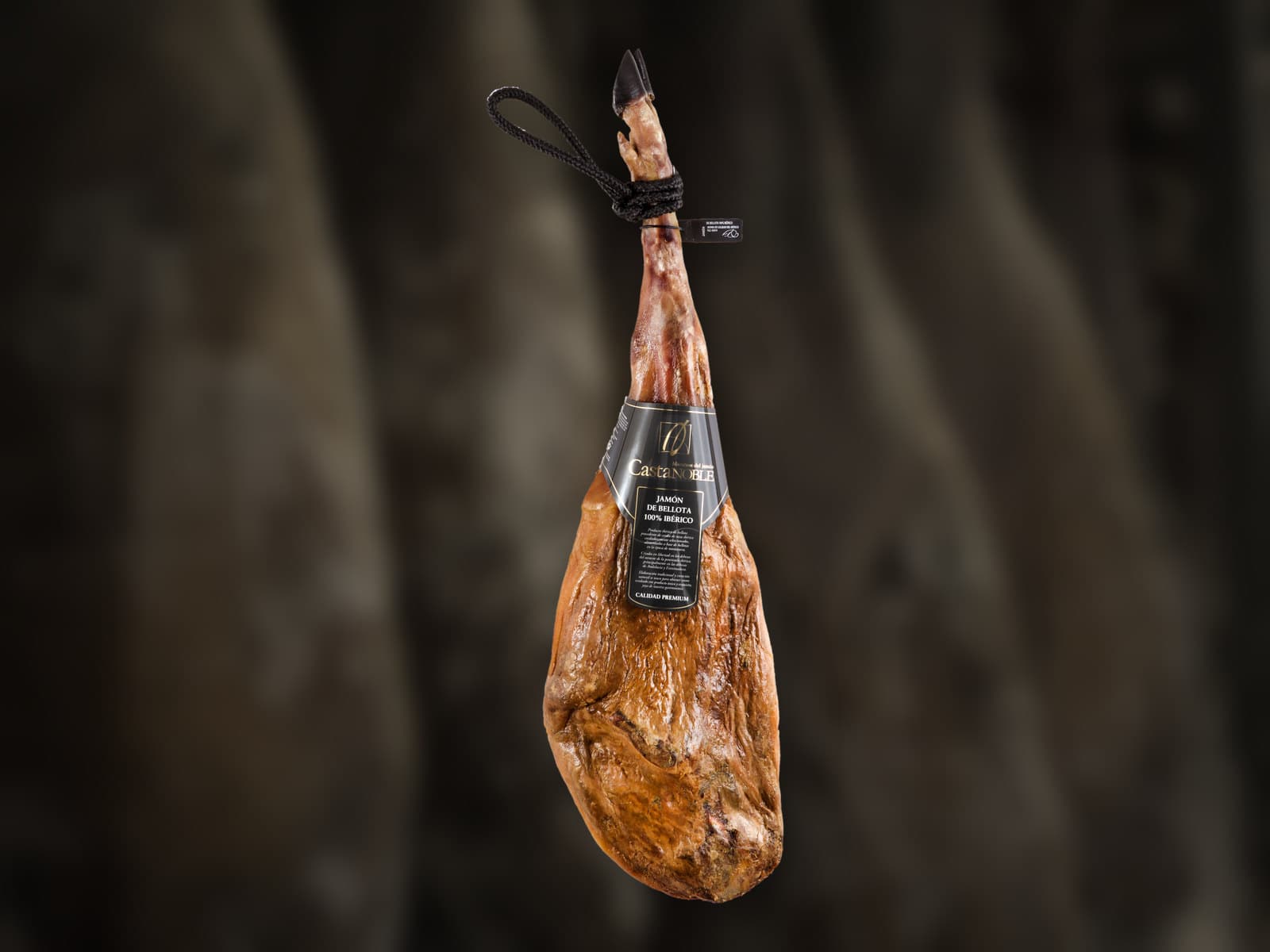
Choosing a good ham means making four decisions, in this order: which pig, what quality, what size and what format. Everything else, the label and the appearance of the ham, helps you check that you are getting what you decided on.
In four steps
- Iberico or white pig: this is the decision that changes the flavour and the price the most.
- If it is Iberico, the quality grade: acorn-fed (de bellota), free-range grain-fed (de cebo de campo) or grain-fed (de cebo).
- Size: ham or shoulder, and how many kilos, depending on how many of you there are and how long it needs to last.
- Format: whole, boneless or sliced.
1. Iberico or white pig
Iberico ham comes from pigs that are at least half Iberico breed and is governed by its own standard. All other cured hams come from white pigs, and their label may carry a designation according to curing time: ‘bodega’, ‘reserva’ or ‘Gran Reserva’. Among white pig breeds, the most prized for ham is Duroc, for the fat it marbles into the meat. Iberico has more intramuscular fat and a longer-lasting flavour; a good, long-cured white pig ham is milder and costs less. Neither is ‘the right one’: it depends on what you want it for.
2. If it is Iberico, which quality
The standard recognises three, depending on what the pig ate and how it lived: de bellota (acorn-fed), which finishes its fattening in the dehesa on acorns and grass; de cebo de campo (free-range grain-fed), feed and the outdoors; and de cebo (grain-fed), feed, on a farm. In addition, the label states how much Iberico breed it has: 100%, 75% or 50%. For a special occasion or a gift, de bellota (acorn-fed); for having ham at home regularly, a well-cured ham de cebo de campo (free-range grain-fed) or de cebo (grain-fed) offers a great deal for what it costs.
3. Ham or shoulder, and what weight
Ham is the hind leg and shoulder the front leg: smaller, with a slightly more intense flavour, proportionally more bone and cheaper. If there are only a few of you at home or it is your first one, a shoulder will be finished while still at its best. For a family or the festive season, a ham. Bear in mind that, once sliced, you get around half of its weight from a ham and slightly less from a shoulder.
4. Whole, boneless or sliced
Whole is how it keeps longest and how it is most enjoyed when carving, but it requires a ham stand, a knife and some practice. Boneless takes up little space and is easy to carve. Sliced and vacuum-packed is simply open and serve: the most practical option if you eat it occasionally or if nobody at home carves.
What to look for on the label
- For Iberico, the label: a coloured tag on the leg. Black label, de bellota (acorn-fed) 100% Iberico; red label, de bellota (acorn-fed) Iberico; green label, de cebo de campo (free-range grain-fed); white label, de cebo (grain-fed). Without a label, it is not Iberico. On packs of sliced ham, that colour appears on the printed label.
- The full name: it must state the feeding and the percentage of Iberico breed. Be wary of stand-alone words: only acorn-fed (de bellota) 100% Iberico ham may be called ‘Pata Negra’.
- For white pig ham, the time designation: ‘bodega’, from 9 months; ‘reserva’, from 12; ‘Gran Reserva’, from 15.
- Curing: these are legal minimums. An Iberico ham cannot be released with less than 600 days (730 if it weighs 7 kg or more); good ones go well beyond those figures.
What to look at with the ham in front of you
- The shank, the narrow part of the leg next to the hoof: in Iberico it is slender, and the more Iberico breed the ham has, the slimmer it is. A thick shank is typical of white pigs.
- The outer fat: plentiful and somewhere between white and yellowish in colour. An orange or brown tone is a warning sign of rancid fat. In Iberico it is also soft: it gives when you press it with your finger.
- The feel: firm but not hard. A ham that feels like a stone has been dried for too long.
- When cut: deep red lean meat with streaks of fat, and glossy fat. The tiny white specks that sometimes appear are tyrosine crystals, an amino acid from the meat's proteins that crystallises over time: the longer the curing, the more crystals. They are not a defect but a sign of long curing.
And what if you buy it online?
Then you cannot look at the ham itself, and what matters is what the shop tells you and lets you choose: the grade and breed percentage spelt out in full, the months of curing, the weight of the ham and what happens if it does not arrive in good condition. At Castanoble you choose the weight and the degree of curing, more tender or more cured, and one of our specialists selects the ham.
Three common mistakes
- Choosing by the hoof. There are Iberico pigs with pale hooves and white pigs with dark hooves.
- Choosing on price alone. Two hams at a similar price can be very different: the label is what counts.
- Buying more than you are going to eat. An opened ham keeps for weeks, not months: better a shoulder that is finished at its best than a ham that dries out.
Iberico acorn-fed, free-range grain-fed and grain-fed ham, and Gran Reserva cured ham.
View the hamsThe front leg: smaller and with a more intense flavour.
View the shoulders