
Jamón de bellota (acorn-fed ham): what it is, how to recognise it and which to choose
The Castanoble team · 7 min read
Published on 9 February 2017 · Updated on 4 October 2026
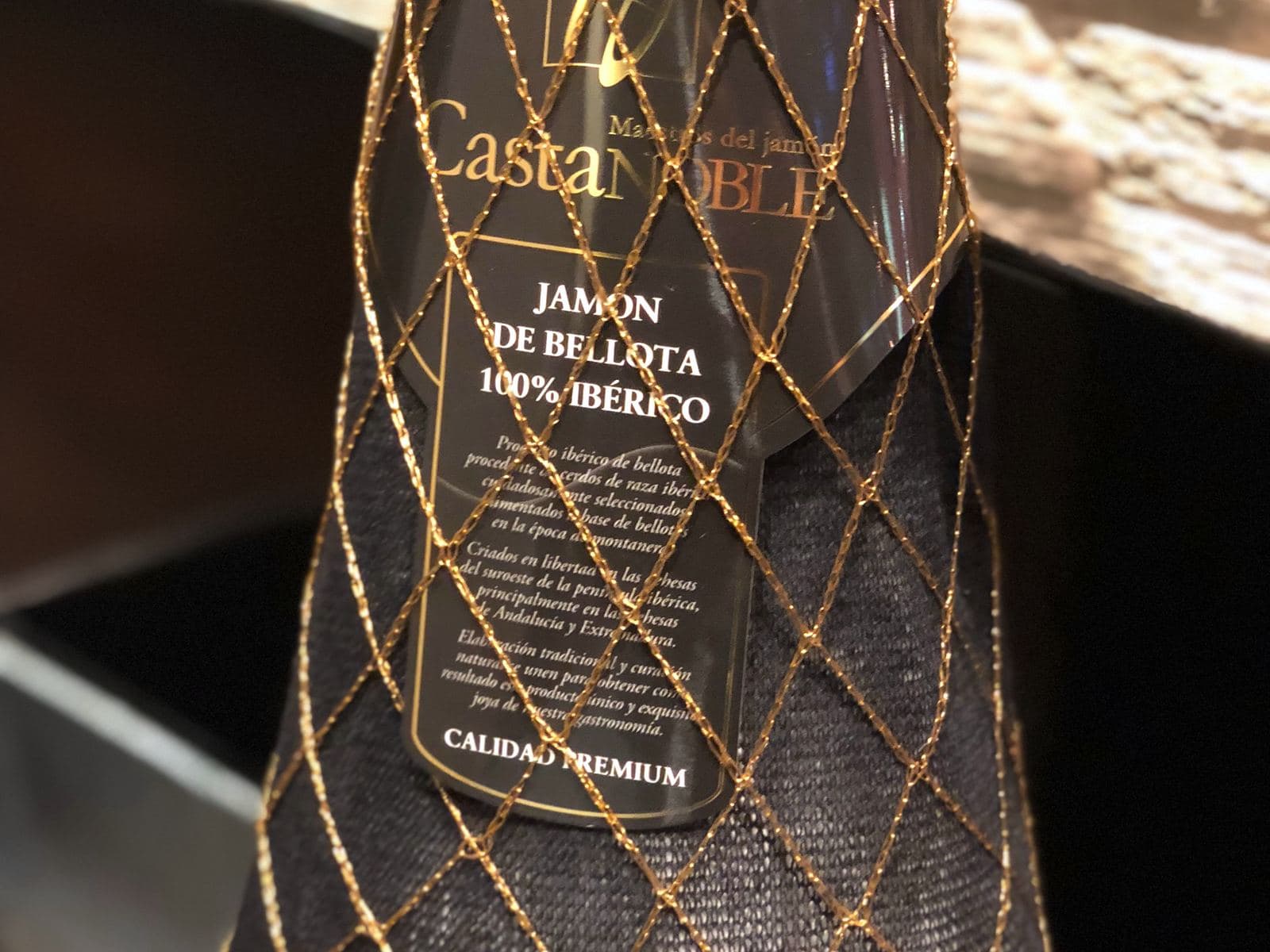
‘De bellota’ (acorn-fed) is one of the most used and least understood terms on a ham. It is not a way of saying it is good, nor a brand, nor an area: it is a category defined by law, with specific conditions on what the pig has eaten and how it has lived. A jamón de bellota (acorn-fed ham) comes from an Iberico pig that has completed its final fattening in the dehesa, roaming freely, eating acorns and pasture. Everything else — the price, the sheen of the fat, that sweet, long flavour — comes from there.
What the standard requires for a ham to be called ‘de bellota’ (acorn-fed)
The Iberico Quality Standard (Real Decreto 4/2014) classifies each ham by two things: the pig's feeding and management, and its breed. ‘De bellota’ (acorn-fed) is the answer to the first: pigs fattened in montanera, on acorns and pasture. The other two possible answers are ‘de cebo de campo’ (free-range grain-fed), raised outdoors on pasture and feed, and ‘de cebo’ (grain-fed), raised on a farm on feed. A ham is not ‘a little bit de bellota’: either the pig did the montanera or it did not.
The montanera: autumn and winter in the dehesa
The montanera is the final fattening phase. When the acorns ripen and fall, the herds go out into the dehesa — holm oaks and cork oaks scattered over pasture — and feed on what they find: acorns and grass. It is regulated: the pigs enter the dehesa between 1 October and 15 December, and must spend more than sixty days there. They walk a great deal and eat slowly, and those two things, exercise and acorns, are what change the meat.
That is why de bellota (acorn-fed) ham is expensive and cannot be otherwise: each pig needs a great deal of land and an entire season, and the acorn harvest is what it is each year. More montanera cannot be manufactured.
Black label and red label: the two de bellota (acorn-fed) hams
Within de bellota (acorn-fed), the breed separates two hams, and each one carries its coloured label on the shank. It is fitted by the slaughterhouse, with a unique number for each piece, and must remain there until the piece is sold.
- Black label: de bellota 100% ibérico (100% Iberico acorn-fed). Pigs of 100% Iberico breed, from breeding stock registered in the herd book. It is the only one the standard allows to be called ‘pata negra’.
- Red label: de bellota ibérico (Iberico acorn-fed). The same montanera, with a crossbred pig of 75% or 50% Iberico breed.
The acorn is fully present in both. What changes is the genetics: the 100% Iberico marbles its fat slightly more finely and gives a more intense slice; the red-label ham is, for many people, the best balance between what you pay and what you enjoy. If it is your first de bellota (acorn-fed) ham, start with the red label.
How it shows in the slice
- The fat: fluid and glossy, it softens with the warmth of your hand. It is the first thing you see and what most distinguishes a de bellota (acorn-fed) ham from a de cebo (grain-fed) one.
- The marbling: fat infiltrated within the lean, not just around it.
- The flavour: sweet, long, with a finish that lingers. It is not saltier or stronger; it is more persistent.
- The aroma: it opens up at room temperature. A de bellota (acorn-fed) ham straight out of the fridge seems like a different ham.
A word of warning from the trade: none of this can be seen from the outside. The shape of the hoof, the slenderness of the shank or the colour of the rind certify nothing. The only thing that certifies that a ham is de bellota (acorn-fed) is its label — or, on a pack of sliced ham, the label of that same colour.
Time: what the label does not tell you
The label tells you what pig it was; it does not tell you how long the piece has been cured. And a de bellota (acorn-fed) ham needs time: its fat withstands, and benefits from, long cures that would dry out a leaner ham. Our de bellota 100% ibérico (100% Iberico acorn-fed) ham is cured for more than 48 months, and the de bellota ibérico (Iberico acorn-fed) ham (50% Iberico breed), for more than 36. The shoulders, being smaller pieces, for more than 24. We cure them in our curing house in Castilla y León, and the months are stated on each product page.
De bellota (acorn-fed) ham or shoulder
The ham is the hind leg and the shoulder the front one. Same pig, same montanera, same label. The shoulder is smaller and has proportionally more bone: from a ham you get roughly half its weight in slices, and from a shoulder, around forty per cent. In return it cures sooner, has a more direct flavour and lets you try de bellota (acorn-fed) with a more manageable piece. For a household of two or three people it is usually the sensible choice.
Whole, boneless or sliced
- Whole, bone-in: the complete experience and the one that keeps best. It calls for a ham stand, a knife and a bit of skill.
- Boneless: the same ham without the bone, for slicing by machine or by knife without a ham stand. No waste.
- Sliced: vacuum-packed packs, ready to open a little while beforehand and serve. To give to someone who is not going to start carving, or to have de bellota (acorn-fed) ham at home without starting a whole piece.
A de bellota (acorn-fed) ham is a montanera, a breed and a few years in the curing house. The label certifies the first two; the third is down to whoever cures it.
Are de bellota (acorn-fed) ham and pata negra the same thing?
No. ‘Pata negra’ can only be said of de bellota 100% ibérico (100% Iberico acorn-fed) ham, the black-label one. A red-label de bellota ibérico (Iberico acorn-fed) ham is de bellota, but it is not ‘pata negra’. And the colour of the hoof certifies nothing: what certifies it is the label.
Does the de bellota (acorn-fed) pig only eat acorns?
During the montanera it eats acorns and the pasture of the dehesa. Before that phase, like any Iberico pig, it has been raised on pasture and natural cereal-based feed. What defines de bellota (acorn-fed) ham is that final free-range fattening, which is what transforms the fat.
Why does the fat of de bellota (acorn-fed) ham glisten and melt?
It comes down to what the pig has eaten. Acorns produce a more fluid fat than that of a pig fed only on compound feed, which is why it softens at room temperature and leaves that sheen on the slice. It is also why it should always be served at room temperature: when cold, that fat is hard and has no aroma.
How should a de bellota (acorn-fed) ham be stored?
The whole piece: in a cool, dry place, at a stable temperature; once started, with the cut surface covered with its own fat and a cotton cloth. Sliced: in a cool, dry place or in the fridge; if you keep it chilled, take it out a while before serving so that the fat regains its proper texture.
The black label: 100% Iberico de bellota (acorn-fed) ham, cured for more than 48 months
View the 100% Iberico de bellota (acorn-fed) hamThe red label: Iberico de bellota (acorn-fed) ham, more than 36 months
View the Iberico de bellota (acorn-fed) hamAll the de bellota (acorn-fed) products: whole, boneless and sliced
View hams and shoulders